Friday, February 10, 2017


Outright corruption in the US

How corrupt is the US? So corrupt you can apparently buy yourself a cabinet position:

Donald Trump's new Education Secretary reportedly donated nearly $900,000 over the years to the Senators who confirmed her into the job.

Betsy DeVos was a controversial choice for the role and was criticised for her performance before the Senate confirmation committee.

She has previously spoken of her desire to “advance God's kingdom” though the education system. She also candidly admitted that she “expects something in return” for her money when it came to political donations.


In civilised democracies this simply wouldn't be acceptable. Making a decision on someone who has given you large donations in the past is clearly a conflict of interest and should cause recusal. But in the US, its apparently not a problem - which leads to the perception that DeVos has outright bought her cabinet spot.

The US really needs to clean out its political sewer. And the first step is eliminating money from politics.

Thursday, February 09, 2017


About fucking time

After dithering for years pretending it was all too hard, the government is finally going to get around to following the lead of the UK and pardoning victims of past discrimination against homosexuals:

Historic convictions for sex between men in New Zealand will be quashed, Justice Minister Amy Adams has announced this afternoon.

In a significant victory for campaigners, the move will allow nearly 200 people convicted before homosexual law reform in 1986 to have their convictions erased.

It will not be an automatic or blanket pardon. Instead, the Government will consider pardons on a case-by-case basis.


Good. Its not enough, of course - this legislated bigotry destroyed lives and literally killed people. But this is a small start towards making amends.

Sweeping failure under the carpet

From 2001 to 2010 the Ministry of Social Development published an annual Social Report, a collection of time-series data on various social indicators. But in 2010, national decided that it contained too much bad news about the effects of their policies, so they shitcanned it. Supposedly, it was moving to triennial publication, but the 2013 report never appeared. But now I've learned that they quietly published a 2016 Social Report in June last year. I've checked the Beehive website, and unlike past reports there's no accompanying PR. It's almost as if the Minister didn't want people to notice it or something...

And no wonder. Because the report shows things are going badly. Inequality is rising, as is poverty. Suicide rates among young people and Maori have increased significantly, as has psychological distress. These are national's problems, they own them. But rather than admitting that, they seem to be trying to sweep them under the carpet.

(See also: Gerry Brownlee in parliament yesterday objecting to a question about child poverty. They do not want to talk about these issues).

I'm glad to see the Social Report back. But its return highlights how necessary it is. It should be published annually, not every three years under cover of darkness. And if the Minister won't do that, then Parliament should legislate to force them to.

UK Ministers knowingly ignored the law on arms sales to Saudi Arabia

UK law prohibits arms sales where there is a clear risk that the weapons will be used to commit war crimes. Despite this, the UK exports weapons to Saudi Arabia, where they are used to murder Yemani civilians. Those exports are currently being challenged in court, and it turns out that Ministers ignored clear warnings that they were illegal:

Sajid Javid refused to halt weapons exports to Saudi Arabia last year despite being warned by a senior civil servant that the sales should be suspended over human rights concerns.

The then business secretary was told a year ago about concerns that weapons could be used to kill civilians in Yemen, according to ministerial correspondence that emerged on the first day of a judicial review into UK arms sales to Saudi Arabia.

Edward Bell, head of the Export Control Organisation, wrote in an email about the decision: “To be honest, and I was very direct and honest with the secretary of state, my gut tells me we should suspend [weapons exports to the country].”

[...]

Javid, however, upheld the weapons licences even though he acknowledged to cabinet colleagues there was “uncertainty and gaps in the knowledge available” of how they would be used, a London court heard.


The government's defence? That it's a "political" decision in which the courts should not interfere. Except that parliament has passed a law saying that its not and that they must. But in the corrupt UK apparently the law means nothing - what's important is showing support for traditional allies, no matter how evil they are, and protecting "British jobs" (by which they mean business profits) in the immoral weapons industry.

I'm not sure what the penalty is for knowingly allowing illegal arms exports, but I'd hope that those responsible face jail. Instead, this being the UK, they'll probably get knighthoods or something.

Why is basic equality so hard for Labour?

Vernon Small has a piece in Stuff this morning about Labour's efforts to get a more representative caucus, and how they're finding it "too hard":

It may come as a surprise to some that Labour is still committed to its aim of achieving a a gender-balanced caucus after the next election.

Because in light of recent events – not least leader Andrew Little's shoulder-tapping of Willie Jackson, the recruitment of former police union boss Greg O'Connor and Paul Eagle's unopposed selection in Rongotai – you might be forgiven for thinking it is being honoured and breached at the same time.

In fact, it is also being not-so-subtly redefined. The aim when the policy was announced in 2013 was to target balance at certain key polling points, since anything more nuanced would be impossible without knowing a vast number of variables in advance –who won what seats, for instance.

But there is an acknowledgment now that it simply cannot be achieved at 25 per cent (without sacking a whole lot of male MPs), is near impossible at 30 per cent and could be in view at 35 per cent, though by no means assured even then.


Why is Labour finding this so hard? The Greens don't - they simply alternate genders along their list, woman, man, woman, man. They're imbalanced if they get an odd number of MP's, or if there's a mid-term replacement, but its a clear commitment. Electorate seats complicate this somewhat, but an equal list would be a great first step - and its not as if Labour has a problem selecting great woman candidates for winnable seats.

The problem comes down to the issue Small highlights: the reluctance to "sack" (or rather, give lower list priority to) those underperforming, stale male MPs. People like Trevor Mallard and Clayton Cosgrove, who are simply being a parliamentary waste of space. These are not people who are earning high list placements - hell, last election they campaigned on winning their electorates rather than the all-important party vote, effectively shafting their party (and now Mallard can't even be bothered doing that). So why are they being rewarded? Labour is not short of talented women, and they shouldn't be excluded just for fear of offending dead white incumbent males.

Wednesday, February 08, 2017


National lies on housing

Last year, Bill English promised to build 30,000 new houses in Auckland to ease the city's housing crisis. But the reality turns out to be a little different:

Housing NZ has revealed it will only add an extra 722 state houses in Auckland over the next three years, leading Labour to accuse the Government of "smoke and mirrors" over its promises to address the housing crisis.

[...]

Speaking to Parliament's social services committee on Wednesday, Housing NZ chief executive Andrew McKenzie said the Crown agency intended to build 4900 new homes in Auckland over the next three years.

However, when the demolition of existing state houses was taken into account, McKenzie said there would only be a net increase of 722 houses - just over 240 each year.


Which is better than nothing, but not even a drop in the bucket compared to the thousands of people on Housing NZ waitlists in Auckland, let alone the thousands more who can't even get onto a waitlist because it would make the stats look bad.

It is clear that National is not committed to solving the housing crisis. They don't believe in state action, so they're fundamentally incapable of doing what is necessary to resolve this massive market failure. If we want housing fixed, we need a new government.

Open Government: Assessing participation and co-creation

The Open Government Partnership has released new standards for participation and co-creation. So how does New Zealand measure up? Badly. Here's a quick look through the basic requirements for "throughout the OGP cycle":

  • National OGP website: Pass. There is one, at http://www.ogp.org.nz/.
  • Lead agency clearly identified: Fail. There's a buried note that the Minister of State Services is the responsible Minister, but nothing about agencies. Contact details are hidden behind a form and there is no hint at where they go.
  • Documents published in all administrative languages: Mixed. OGP documents are published only in English, which is normal for the NZ government. But Maori is an official language of New Zealand, and publication in Maori seems to be what is required.
  • Document repository of OGP documents: Fail. The official site contains nothing beyond the current Action Plan. There is some older material at the SSC's site, but it is far from complete. Old consultation documents and IRM reports are notable by their absence.
  • Information communication to stakeholders in advance: Fail. The NZ government has extremely poor consultation practices, despite a "commitment" in the previous Action Plan to improve them.
  • Multi-stakeholder forum: Mixed. There is such a forum - the Expert Advisory Panel - but it does not meet regularly (and indeed, apparently has not met since the Action Plan was developed in the middle of last year).
  • Multi-stakeholder forum accepts inputs from civil society: Unknown, as it no longer appears to meet. Base don passed practice it is unlikely though.
  • Remote participation in multi-stakeholder forum: Unknown, as there is no information on whether it even accepts outside input.
  • Direct communication with stakeholders on NAP process questions? Fail. Based on past Action Plan processes, SSC is not interested in hearing from us.
  • Outreach and awareness raising? Fail. Other than a passive website, the government does nothing to promote knowledge of the OGP or encourage participation except during Action Plan development.
  • Multi-stakeholder forum is independent of government: Fail. The EAP is controlled by SSC, meets at its demand, and considers its agenda. It does not set its own agenda, choose its own membership, or meet independently of SSC.
  • Multi-stakeholder forum includes even balance of government and non-government representatives: Technical fail. In fact, the membership is entirely non-government.
  • Non-government members are selected via a fair and transparent process: Fail. They're selected in secret by SSC.
  • Multi-stakeholder forum proactively communicates with public: Fail. Apart from the lack of meetings, they do not issue statements, and minutes are controlled by SSC.
  • Multi-stakeholder forum includes Minister: Fail.

This certainly doesn't look very good. And while its a new standard, its base don best practice, things our government should have been doing anyway. The government is going to have to significantly improve if it wants to avoid further criticism from the OGP Independent Reporting Mechanism on this issue.

Scotland rejects Brexit

The Scottish Parliament has formally voted to reject Brexit:

The Scottish Parliament has formally rejected Theresa May’s plans to begin the UK’s withdrawal from the EU, with politicians from every party except the Conservatives uniting to vote against the triggering of Article 50.
A clear majority of MSPs supported the Scottish Government’s motion that the Prime Minister’s Bill giving the green light to the EU withdrawal process “should not proceed”, passing it by 90 votes to 34.

More than 62 per cent of Scots voted to remain part of the EU at last June’s referendum and only one of the nation’s 59 MPs, the Scottish Secretary David Mundell, supported the Bill at Westminster.


Its symbolic only: the courts have said Scotland's consent is not required, and for some reason the SNP decided not to do this as a formal Legislative Consent Motion. But it lays the groundwork for another independence referendum should England decide to force Scotland out of the EU.

Tuesday, February 07, 2017


Labour doesn't need more bigots

What is up with Labour? First there was their backing of former Police Association spokesperson and jackbooted fascist Greg O'Connor, and now over the weekend Andrew Little has lent his support and promised a high list placing to serial rape apologist and homophobic bigot Willie Jackson. Little says he was "aware of the risk" of backing someone so at odds with Labour's values, but I'm not sure that he is. There's the obvious damage to Labour's brand of course, and to its support among women (who may be less willing to vote for a party which openly promotes this sort of scumbag). But Young Labour is also angry. And they're the people who actually do the work on Labour's election campaign and make intense ground campaigns like Mount Roskill and Mount Albert possible.

To point out the obvious, if Labour insists on making Jackson a candidate, all those Young Labour volunteers could simply withdraw their labour, or apply it elsewhere to candidates and parties more in line with their values. And IMHO they should do so if the party isn't interested in what they think.

As for Little, if the Jackson decision is an example of his leadership, then Labour needs a new leader. It is that simple. Someone with such poor judgement is not suitable to be a party leader, let alone Prime Minister.

We need more young MP's

One of the benefits of MMP is that it has given us a Parliament which looks far more like New Zealand. Not nearly enough - it still under-represents women and ethnic groups other than Pakeha and Maori - but our House is a far more diverse place than it was in the Bad Old Days of FPP where you could count the number of MPs who weren't dead white males on the fingers of one hand.

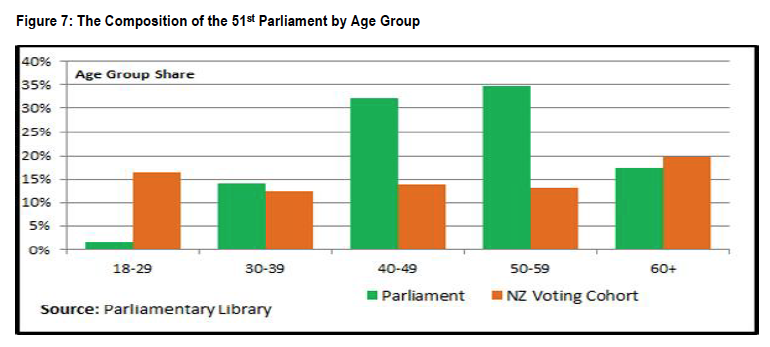
One of the areas we still do very badly in is representing younger people. The problem is apparent from this graph, stolen from Bryce Edward's article on the demographics of the 51st Parliament:
51stparliament-age

As you can see, we over-represent the middle-aged, while there are very few people representing the under-30's.

This is a problem. It undermines our democracy, and it has significant effects on policy. You can't help but feel that if decisions on the environment and child poverty were being made by people who will actually have to live with the consequences, they would end up in a very different place.

All of which is background to this morning's comment by (middle-aged) political commentator Bryce Edwards opposing the Greens selecting younger candidates that "I just don't think we want a parliament full of 20 and 30 year olds". Obviously, we don't want a Parliament full of one demographic to the exclusion of all others - that would be unrepresentative. Equally obviously, we don't have that, and the Greens selecting younger candidates won't result in that outcome (it might increase 20-30 representation from the current ~2% to maybe 4% if they're wildly successful). But most importantly: we clearly need more young MPs, and the Greens are on the right path from a representational point of view. As for Edwards, his comments just come across simply as Trotteresque privileged whining, identical to those who whine about "too many" women on party lists (hint: anything less than 50% is not "too many").

We need more young MP's, so our Parliament looks like New Zealand and the interests of the young are properly represented. And clearly, we need more young political commentators as well, so that we're not constantly swamped with the opinions of privileged old white dudes.

"Better economic management"

So, it turns out that not only did National give billionaire vampire capitalist Peter Thiel NZ citizenship because he was rich - they also gave him tens of millions of dollars of public money because they couldn't write a contract properly:

A scheme funded by New Zealand taxpayers netted billionaire Peter Thiel tens of millions of dollars while his publicly funded investment partner barely broke even.

The partnering of Thiel's Valar Ventures and the Government-owned New Zealand Venture Investment Fund (NZVIF) was launched by minister Steven Joyce in March 2012, nine months after Thiel took his oath of citizenship at the New Zealand consulate in Santa Monica.

Joyce said at the time the venture was "part of the Government's comprehensive business growth agenda", but a Herald investigation has discovered the arrangement was quietly ended in October when Thiel activated a generous buyback option allowing him and his private partners to claim all profits from the venture by cheaply buying out his public co-investor.


Basicly, NZVIF's investment contract was written to privatise gains while socialising losses, and Thiel took us to the cleaners using it. Its been changed now, but it should never have happened in the first place. But that's what happens when your policy is focused on producing positive headlines like "billionaire invests in NZ!" rather than on protecting the public interest.

National purports to be better economic managers. Instead, they focus on enriching the rich and looting the state for the benefit of their donors and cronies. Isn't it time we had a government which cared about us, rather than National's tiny clique of friends?

Farmers are stealing our rivers

Agricultural intensification has led to an environmental crisis in New Zealand, with irrigation and farm waste effectively privatising our rivers into sewers for greedy farmers. But its not just our water the farmers are stealing - in Canterbury, they're stealing our land as well:

The fringes of some Canterbury rivers have been absorbed into expanding farms, resulting in the loss of thousands of hectares of public land to private development.

The issue – known as "agricultural encroachment" – has happened incrementally over several decades, and is adding to the many pressures facing the region's internationally significant braided rivers and the rare ecosystems they host.

Environment Canterbury (ECan) research found that nearly 12,000 hectares of Canterbury's river margins had been taken over by intensive farming between 1990 and 2012.

About 60 per cent of that land was developed through private land sales, but nearly one-quarter was public reserve land effectively privatised and developed.

Authorities in charge of public land all acknowledged that land had been taken and developed without permission.

None of them were able to quantify how much, and in some cases, the encroacher was allowed to keep the land after meeting certain conditions.


These land thefts have prevented public recreational use of rivers, destroyed local ecosystems and threatened rare indigenous species. And by permitting the thieves to normalise their tenure, government agencies have been rewarding and encouraging this theft.

This isn't acceptable. This is public land and it should stay public. Farmers who try and steal it should not be rewarded. Instead, they should be prosecuted and jailed, just as you or I would be if we stole part of someone's backyard.

Friday, February 03, 2017


National's "growth"

When he announced the election date earlier in the week, Prime Minister Bill English said that the election would be about "growth". but in Palmerston North, the only "growth" we're seeing is a massive growth in foodbank demand:

Palmerston North free food store Just Zilch is dealing with unprecedented demand as almost 300 people stop in daily.

Since reopening in January after the Christmas - New Year break, the store's founder Rebecca Culver said they'd noticed an increase in people from all walks of life through the doors.

"The average has crept up to just over 200 a day. Some days we're dealing with 260 - 270 people. On Monday there were 264. It's crazy - numbers that we've never experienced before," Culver said.


This is what National's "growth" means in practice: people too poor to eat queuing hours for free food. But I guess they just don't see that in Karori.

NZDF should not be allowed to recruit children

There was a disturbing article in the Independent a few weeks ago about the UK's recruitment of child soldiers. The UK is one of the few countries which allows people under 18 to join the armed forces, and the British Army specifically targets schools for recruits. Under-18's make up a quarter of their total recruits, and as they lack formal qualifications, end up being assigned to the infantry. Where they end up as cannon-fodder in America's imperial wars:

Sharrocks joined the Army in 2006, aged 17. He left in 2013 and has since suffered mental health problems. The UK is the only country in Europe – and one of only a handful in the world – that recruits under-18s into its Armed Forces. Groups campaigning against the practice argue that the youngest recruits are most susceptible to developing mental health problems such as PTSD – and dying in action.

[...]

From 2015 to 2016, the Army enlisted 8,020 soldiers of whom 1,790 were aged under 18, according to CSI. Even though the latter will not see battle until they come of age, the organisation’s study of Afghanistan suggests they will remain twice as likely to be killed once they do.


Like Britain, New Zealand also allows the recruitment of minors (though like Britain, they are forbidden from serving on active service). According to an OIA I lodged last week, roughly an eighth of New Zealand army recruits are children. Unlike the UK, we don't fight for America, so the effects aren't nearly as bad. Still, its disturbing - especially when New Zealand was one of the lead campaigners for the Optional Protocol on the Involvement of Children in Armed Conflict. We're consistent with its wording - no children in combat - but not its spirit, in that we still train children to be killers.

This isn't something we should do. Instead, we should follow civilised countries and prohibit minors from enlisting. It would be an easy amendment - simply replace section 36 of the Defence Act with a statement that "a person under 18 years of age shall not be eligible to enlist or be accepted for service in the Armed Forces". The question is whether MP's want to behave like a civilised country or not.
New Fisk

What the history of Greece can tell us about the fight against Isis

But why would we want that?

Radio New Zealand warns that a post-TPPA trade deal with the USA would lead to higher pharamceutical prices, as the US enforces the "right" of Big Pharma to price gouge:

New Zealand may have to swallow higher drug prices if it wants a trade deal with the United States.

US President Donald Trump had already set out one bottom line for a bilateral trade deal with prospective suitors: a 30-day break clause in agreements, which New Zealand Prime Minister Bill English called unattractive.

This week Mr Trump told American pharmaceutical executives that other countries had not paid their fair share, and US trade policy would change to ensure that happens.

"We're going to be ending global freeloading. Foreign price controls reduce the resources of American drug companies to finance drug and R&D innovation. I think you people know very well, it's very unfair to this country," Mr Trump said.

"Our trade policy will prioritize that foreign countries pay their fair share for US-manufactured drugs."


But why would we sign up for that? The TPPA was so loaded with American bullshit (longer copyright terms, regulatory subsidies to Big Pharma, and of course the investor-state disputes clause) that there was basicly nothing in it for New Zealand. It was a deal not worth doing. This would be even worse. So why would we even open negotiations, let alone agree to such a deal?

Thursday, February 02, 2017


This smells II

Yesterday the Department of Internal Affairs finally released the documentation on vampire capitalist Peter Thiel's citizenship. And lo and behold, it turns out that the "exceptional circumstances" relied upon by the Minister in approving Thiel's citizenship despite his never having lived in New Zealand was that he was rich:

"Given the investment Mr Thiel has made in New Zealand companies and the support and contacts he is able to provide, the Department is of the view that granting Mr Thiel's citizenship would be in the public interest due to his exceptional circumstances," the report concluded.

And there you have it: under National, if you wave enough money around, they'll give you citizenship. They sell it to the highest bidder, just like Tonga.

As for what to do about it, increased transparency seems to be in order, both around "exceptional" grants of citizenship, and (to ease our minds) political donations. Because currently we have no way of knowing who National has been selling to - or what they have been given in return. If we want to be non-corrupt, lets be non-corrupt - and scrutinise our government and politicians properly so that we can be seen to be clean.

Wednesday, February 01, 2017


National pisses on another Treaty settlement

In 2014, Parliament passed the Ngāti Kōata, Ngāti Rārua, Ngāti Tama ki Te Tau Ihu, and Te Ātiawa o Te Waka-a-Māui Claims Settlement Act 2014, which settled the outstanding Treaty claims of those iwi. During the settlement negotiations, the iwi had quite rightly demanded their share of aquaculture space in the Marlborough Sounds (itself guaranteed by the 2004 commercial aquaculture claims settlement), only to be told that there was no free space to give. But now, the government seems to be unravelling both those settlements with a proposal to move a group of salmon farms to new sites:

The chairman of an iwi fisheries forum has lashed out against a plan to relocate up to six salmon farms in the Marlborough Sounds, accusing the Government of dealing in bad faith.

The Ministry for Primary Industries wants to relocate five New Zealand King Salmon farms in Pelorus Sound and one salmon farm in Tory Channel, and claims the changes would bring economic and environmental benefits.

Te Tau Ihu customary fisheries forum chairman Richard Bradley said the plan was "not honourable".


And he's right. The government's position, pretending that these spaces aren't new, effectively says that space is available for aquaculture by Pakeha but not for Maori. And that's not just dishonourable - its deeply racist.

It also continues National's disturbing trend of ignoring the settlements it has worked so hard to complete, which in turn threatens the entire settlement process. After all, if the government doesn't regard settlements as binding, why should Maori? Again, if the government wants Treaty settlements to stick, it needs to obey them.

Pardoned

For several years now the UK has had a process allowing those convicted of consensual homosexual acts under outdated, bigoted laws to have their convictions expunged. Today, they went a step further and issued a blanket pardon to the deceased victims of past bigotry:

Thousands of men convicted of offences that once criminalised homosexuality but are no longer on the statute book have been posthumously pardoned under a new law.

A clause in the policing and crime bill, which received royal assent on Tuesday, extends to those who are dead the existing process of purging past criminal records.

[...]

Welcoming the legislation, the justice minister Sam Gyimah said: “This is a truly momentous day. We can never undo the hurt caused, but we have apologised and taken action to right these wrongs. I am immensely proud that ‘Turing’s law’ has become a reality under this government.”


Meanwhile in "progressive" New Zealand we're still dragging our feet on this, with the Justice Minister only just having got around to getting her officials to look at it. And while it will go to Cabinet, National's inner circle is stuffed with unrepentent bigots: seven of their top ten, including the prime Minister, voted against marriage equality. So its chances probably aren't great.

We can, and should do better. This is something we should be leading the world on. Instead National has made us a slow and reluctant follower.

34,000 unemployed under National

The Labour Market Statistics were released today, showing that unemployment has risen again to 5.2%. There are now 139,000 unemployed - 34,000 more than when National took office.

This is where National has left us after 9 years of government. Persistent high unemployment, stagnant wages, and widespread poverty. The difference from the Cullen years, when unemployment was kept low by manipulating fiscal policy, while wages were pushed upwards by the labour shortage and large and regular increase to the minimum wage, couldn't be any clearer. And the reason for that is obvious: National cares for people at the top, not people at the bottom. They're interested in tax cuts, service cuts, and destroying the environment for private profit, not making sure that ordinary kiwis can enjoy a decent life. The sooner we're rid of them, the better.