Showing posts with label Electoral Act. Show all posts

Thursday, July 24, 2025


An attack on free and fair elections

That's the only way to describe the regime's new Electoral Amendment Bill. The big change is ending same-day enrolment, which enabled over a hundred thousand people to vote last election. National wants to disenfranchise those people. Their excuse? Administrative convenience - because they refuse to properly resource the Electoral Commission to handle the load. But it is simply a cynical attempt to strap the electoral chicken, and prevent those people - primarily young people and those who have moved shortly before the election - from voting.

But that's not the only change. They're re-instating the prisoner voting ban, which explicitly violates the Bill of Rights Act, in the process giving the finger to the carefully negotiated settlement between courts and Parliament over their responsibilities under our constitution. its pure performative punching down, while also helping to gerrymander electorates with prisons in them.

There are other unpleasant changes too:

So, reducing voting rights, transparency, and competition, while creating a one-off opportunity to put their thumb on the electoral scale for the next election. All of this runs completely counter to our democratic norms, and to public demand, which overwhelmingly favours more transparency. Combined with the regime's attacks on protest rights, it paints an increasingly dark picture of the character of this regime - and makes it clear that we need to oust it at the first opportunity.
Friday, August 11, 2023


A question

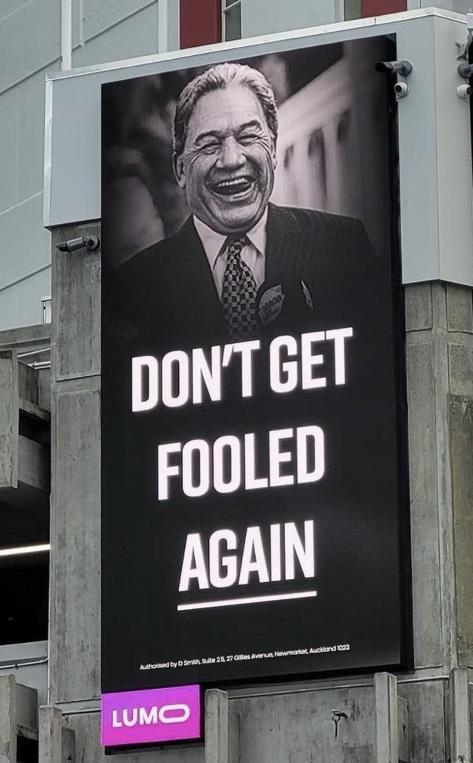
DontgetFooledAd

Is this ad encouraging people to vote for or against NZ First?

In fact, its an ACT ad, intended to discourage people from voting for Winston. But the fact that it is completely indistinguishable from an NZ First ad encouraging people to vote for him doesn't just make it a tremendous advertising own-goal - its also legally problematic. Section 204H(1) of the Electoral Act 1993 provides that

A person may publish or cause or permit to be published a party advertisement that may reasonably be regarded as encouraging or persuading voters to vote for a party only if the publication of the advertisement is authorised in writing by the party secretary.
This ad can clearly "reasonably be regarded as encouraging or persuading voters" to vote for NZ First. The question then is whether ACT sought the written approval of NZ First before running it? If not, well, its not a crime - failing to see the double-meaning in your ad isn't wilful contravention - but ACT probably shouldn't be promoting another political party without their permission.

Tuesday, October 05, 2021


The electoral law review

This morning the government announced an "independent" review of electoral law, to look at "changes to the voting age, the three-year Parliamentary term, funding of political parties, overseas voting and Electoral Commission recommendations on MMP". My feelings about this are... complicated.

Firstly, an independent review of the voting age would be a very good thing, and would hopefully lead to a reduction. But linking it implicitly to a four-year term is really making it a shit sandwich, and casts doubt on the whole exercise. The government has made clear its enthusiasm to be less accountable to the people (which is what a four-year term means), so they're basicly saying this "review" will be of the strapped-chicken variety, with the reviewers carefully chosen to produce the outcome they want. As for the Electoral Commission recommendations, we've already had a review of those, so the government throwing them in is basicly a way of putting off doing anything about them (an outcome I don't mind, because those recommendations would make our parliament less representative, but its slimy and dishonest. OTOH Labour originally supported that package, though that was three leaders ago, so this suggests they've changed their mind. Still slimy and dishonest though, because there's obviously something they've changed it to, which they should be up-front about). As for overseas voting, its inclusion in the review is a clear signal that the government doesn't care about the pandemic's disenfranchisement of kiwis trapped overseas.

But then there's the report-back date: "late 2023" according to the government PR, with changes to be implemented for the 2026 election. Which means a) the government is ruling out a referendum on term-length at the 2023 election (and perhaps entirely, something which would be completely illegitimate); and b) they're perfectly happy for young people to be disenfranchised (and political parties to be corrupt) for another five years. "Transformative"? My arse.

Is it worth engaging with such an exercise in bad faith? Well, the presence of the voting age means I will have to - not doing so would betray young people. But the other stuff means I'm not going to feel happy about it. Participation takes time and energy, which is a limited resource. The government demanding it so it can launder its pre-determined policy and say it has had "public consultation" is just abusive. "Consultation" you were always going to ignore isn't (see also: any national security law with an "abbreviated" select committee process).

It is obvious from the above that I do not trust this process, and I do not trust politicians to make these decisions with party and self-interest corrupting the process entirely. So what process would I like to see? IMHO, the only truly independent review would be one carried out by appropriately supported, randomly-selected citizens: a citizen's jury.

Tuesday, September 21, 2021


Let them vote

A side effect of the pandemic and resulting closed borders: tens of thousands of overseas kiwis could lose the right to vote:

Currently, New Zealanders who are overseas must have visited the country once within the last three years to be allowed to vote - or once in the last 12 months for non-citizen residents. Those who fall outside that threshold lose the right to vote in that election.

With entry to New Zealand currently restricted by the clogged MIQ system, many New Zealanders overseas will lose the right to vote at the next election, unless the law is changed to be more flexible or New Zealand's border becomes significantly more open by 2023.

That currently appears unlikely, with the Government only committing to a gradual reopening of the borders, which is unlikely be normal by 2023 - or 2022, when local body elections are scheduled.

This is easy to fix: change two numbers in s80(1) of the Electoral Act. Doing so seems entirely reasonable, and its arguably something they need to do anyway: Canada's Supreme Court threw out that country's time-limit on non-residents voting in 2019, and a case taken in New Zealand is likely to have the same result (or rather, result in a declaration of inconsistency and intense pressure on Parliament to listen to the courts). The question is, will Labour do it? Or will they make a nakedly political calculation that overseas kiwis are now unlikely to vote for them thanks to MIQ, and refuse?

Monday, July 13, 2020


Our dirty Parliament

The Serious Fraud Office has announced that it is investigating the Labour Party over donations it received in 2017. Which means the three largest parties in Parliament are all now either being investigated or prosecuted for donation fraud. The only parties who aren't are the Greens and ACT.

As with the other parties, if Labour has broken the law, then those responsible should be prosecuted, and if convicted, punished. We can not permit corruption to take root in our political system. And personally, I'll be voting to drive it out.

Tuesday, March 12, 2019


Not a good look

Thanks to the dodgy dealings exposed by former MP Jami-Lee Ross, the National Party appears to have become the first New Zealand political party to be investigated by the Serious Fraud Office:

Police have referred Jami-Lee Ross' complaint about National's election donations to the Serious Fraud Office.

Ross, who was kicked out of the National Party last year, lodged a complaint with police in October.

A police statement today did not refer to Ross by name but said:

"Police have referred to the Serious Fraud Office a complaint received in October last year in relation to the disclosure of political donations under the Electoral Act.

"The complaint has been referred to the SFO as they hold the appropriate mandate to look further into matters raised by the investigation to date.


The mandate of the SFO is to investigate serious or complex fraud. Being investigated by it is a big deal, and (in NZ political jargon) Not A Good Look. Hopefully they'll get to the bottom of any financial shennanigans and efforts to evade the transparency requirements of the Electoral Act and bring anyone who has committed a crime to justice.

Monday, March 04, 2019


Strengthening our democracy?

Over the weekend the Greens introduced a Member's Bill with an assortment of changes to the Electoral Act to strengthen our democracy. The one that seems to be getting the most attnetion is overturning National's repulsive (and unconstitutional) prisoner voting ban, but it would also enable Māori voters to change rolls whenever they want (as recommended by the Electoral Commission), strengthen transparency and disclosure of electoral donations, and lower the MMP threshold and eliminate the one-seat rule (as recommended by the 2012 Electoral Commission review of MMP).

I support most of these changes. The prisoner voting ban is a stain on our democracy. It is inconsistent with the Bill of Rights Act, and it has to go. And it is shameful that the response of our political class to the court ruling saying so has been a giant "meh", rather than urgently bringing the law into consistency with our constitution. The changes to the Māori roll seem like a good idea, though the Greens' drafting means that they are amending entrenched provisions in s35 of the Act. Not substantively, but it does mean that those changes (and the bill itself) would need a 75% supermajority to pass. Which National will use to defeat the very necessary changes to the transparency regime, which would throw open the books on who is trying to buy influence with our political parties.

The one area I don't support is the move to eliminate the one-seat rule. As I noted at the time, the Electoral Commission blew it by recommending a change which would actually make our voting system less representative than it is at present. I support eliminating the threshold entirely, and any reduction in it is a step towards this. But until the threshold is reduced to the level required to win two seats, then removing the one-seat rule will reduce proportionality, and damage our democracy rather than strengthening it. So oddly, I'm hoping that this bill is never drawn, and that the other changes in it are advanced by other bills instead.

Tuesday, October 16, 2018


National's corrupt electoral practices

The National Party mess has just gone thermonuclear, with Jami-Lee Ross making public allegations that party leader simon Bridges repeatedly engaged in corrupt electoral practices. In his unscheduled press standup, he specifically accused Bridges of knowingly falsifying the identity of the "Cathedral Club" donor on his electorate donation return, in violation of s207G of the Electoral Act, and of instructing him to split a $100,000 donation from a "Chinese businessman" in order to avoid disclosure, in violation of s207LA. He says he has recordings and photographs, and will be going to the police tomorrow to make a statement.

(He also says he's been accused of multiple cases of sexual harassment by National Party staffers, which he portrays as a political stitch-up. We can treat that denial with the contempt it deserves)

This is an allegation of serious criminal behaviour. Both of these are corrupt electoral practices, and if convicted, both Bridges and Ross (because he's a self-admitted party to at least one of the offences) would be automatically removed from Parliament. Of course, that assumes the police will bother to investigate. And as we've seen, they are only interested in prosecuting electoral offences by small parties outside Parliament, not by those who might one day set their budget. So, I fully expect that nothing will legally come of this, no matter how compelling Ross' evidence. But if what Ross says is true, it should taint Bridges permanently, and renders him utterly unfit to be in Parliament, let alone a party leader.

Monday, October 08, 2018


The exception that proves the rule

On Friday, the police announced they were charging the secretary of the People's Party with failing to declare donations on time. Great! Parliament has made it clear that they regard this as a crime, and its good to see the police finally enforcing electoral law for once. At the same time, you have to ask: why only the People's Party?

In case anyone has forgotten, the secretary of ACT, Garry Mallett, committed exactly the same offence in 2014, and was duly referred to the police over it. Who then did... nothing. Its as if they have one standard for cimes by people who are in power, and one for people who aren't.

(In case anyone was wondering, its too late to prosecute Mallett now, because politicians wrote themselves a self-serving little time-limit. if the normal rules applied, then it would be a category 2 offence with a 5 year limit for filing charges. its almost as if politicians don't want to be subject to the law like the rest of us dirty peasants...)

Friday, May 01, 2015


The Electoral Commission hates freedom of speech

During the 2014 election campaign the Electoral Commission banned a satirical music video (and the song it related to) on the basis that it was an "election programme" and an "election advertisement" because it might persuade people to vote against the Prime Minister. The decision was ridiculous, and effectively outlawed virtually all political satire, either broadcast or written, and it was naturally overturned by the High Court last month as being inconsistent with the BORA-affirmed right to freedom of expression. But now, the Electoral Commission is challenging that ruling:

The Electoral Commission today filed papers with the Court of Appeal seeking to clarify the meaning of “election advertisement” for the purposes of the Electoral Act following two recent decisions of the High Court that appear to take different approaches to the legal interpretation of its meaning. The Commission is also seeking to clarify the meaning of “election programme” under the Broadcasting Act.

“Clarification is needed to ensure the Commission is able to provide advice and guidance to parties, candidates and third parties on their obligations in respect of electoral matters,” says Robert Peden, Chief Electoral Officer.


The inconsistency? Climate voter is an election advertisement while Planet Key isn't. But that's not an inconsistency, but recognising that satire is different from soliciting votes. And while the Electoral Commission needs to be able to provide clear advice to people on what is an election advertisement and what is not, its unclear why they couldn't simply get Crown Law to get them an opinion (and publish it) rather than threatening the public's freedom to satirise politicians again.

Thursday, April 02, 2015


Political satire is legal again


Back in August, Darren Watson and Jeremy Jones put this amusing political song on the internet and offered it for radio broadcast. The Electoral Commission immediately banned it as an "electoral advertisement" - in the process effectively declaring effective political satire to be illegal. Watson and Jones challenged the Commission's interpretation, and the court has finally ruled - finding that the song and video aren't advertisments at all, but comment, speech and content. Which should have been pretty bloody obvious the moment anyone stopped to think about it.

The full judgement is here. There's a long traversal of the legislative history of the relevant parts of the Electoral Act and Broadcasting Acts, and a discussion of the interests Parliament is trying to protect through the electoral law requirements to attach promoter statements to advertisements and the prohibition on election programmes. And the short version is that they're trying to prevent people from buying elections, not from commenting on politics or producing protest songs. A rights-consistent interpretation of our electoral law has to support that, and fortunately one could be found by highlighting the distinction between advertising and actual content. That works very well for this situation (where, pretty obviously, its not an "advertisement" at all), but there are likely to be further interpretational questions around stealth advertising campaigns. but I guess the Commission, with the guidance of the courts, will deal with them as they come up.

In passing, its also worth noting that the Electoral Commission really did try and ban satire. Yes, they deny it, but that would have been the effect of their argument at paragraph 90 where they argue for a top-down "encourages votes / specified exception" scheme and that

Satirical speech might or might not be an election advertisement, depending upon the “may reasonably be regarded” assessment.

But no reasonable person would conclude that effective satire didn't encourage people not to vote for its targets. While it may not be its purpose, that's the effect of a thorough skewering - to highlight views the public may find repulsive, and lower the public's opinion of the target. And the idea that such speech might be forbidden in a free and democratic society is simply laughable. Which may explain why we don't see very much of it on NZ television (that, and NZ On Air is hardly going to allocate funding to content which skewers the people who set its budget).

But I guess that's what you get when your Electoral Commission is more worried about getting flak from politicians rather than protecting the public's democratic rights.

Tuesday, February 03, 2015


The law is an ass

One of the features of New Zealand electoral law is that we have compulsory voter registration. Anyone qualified to be an elector must register within one month of the date they qualify. "Knowingly and wilfully" failing to do so is a criminal offence, punishable by a fine of $100 on first conviction, and $200 on subsequent ones.

According to the Electoral Commission, no-one has ever been prosecuted under this law in its 22-year history. No-one. The reason? "Prosecution is expensive and does not proceed in any case once an application [for registration] is lodged". In other words, they think its just too much bother.

But if its too much bother to prosecute, its too much bother to have on the books. Laws which are never enforced make the law an ass.

[Thanks to Liam Stoneley on FYI for making this request.]

Monday, September 08, 2014


The Climate Voter decision

When the Climate Voter campaign launched, one of my first thoughts - expressed over Twitter, and directly to their network contact - was that it was an "election advertisement" in terms of the Electoral Act, and was going to get into trouble for not carrying the required promoter statement. And according to the High Court's judgement (released this morning) in Greenpeace of NZ Incorporated & Ors v Electoral Commission [PDF], I was right.

The case was actually about two websites: Climate Voter, which aims to get voters to cast their vote on the basis of climate change policy, and Simon-Bridges.co.nz, which parodied the Minister of Energy and Resource's website and position on oil spills. The core question at issue was whether the law meant what it defined an "election advertisement" by whether it

may reasonably be regarded as encouraging or persuading voters... to vote, or not to vote, for a type of party described or indicated by reference to views or positions that are, or are not, held or taken (whether or not the name of the party is stated)

and the impact of this definition on advocacy organisations. On the way to an answer, the court considered the consistency of the law with the BORA (it is consistent), whether an "advertisement" must be an advertisement in the ordinary sense of the word (no), and whether a corporation is an "individual" for the purposes of the "personal political views" exemption (they're not), before deciding that the definition means what it apparently says. And on that basis, Climate Voter is an "election advertisement" because it goes beyond simply informing people on policy positions, but tells people directly and implicitly through its "live updates" feed what specific positions you should vote for. So, in part, the informal style of Twitter has made it an election advertisement.

But its not all bad news. The judge also rules that whether something is an election advertisement must be assessed in light of the context in which it is created. Ordinary political debate - which the Electoral Act is not supposed to suppress - routinely involves issue groups highlighting the positions of Ministers. This sort of political speech isn't an "election advertisement", and doesn't become one retrospectively when an election is called. So, Simon-Bridges.co.nz is not an "election advertisement".

So, Greenpeace will have to put a promoter statement on its website, track its expenses, and not spend more than $308,000 on it. Quelle horreur! As the judge notes, these are hardly onerous conditions, and I really wonder why Greenpeace spent so much money trying to avoid them.

Thursday, September 04, 2014


Who else is advertising for National?

on Sunday, we learned that EQC was advertising for National, with a double-page spread in the Sunday Star-Times which talked about what a great job the government had made of the hugely contentious Christchurch rebuild. And in Tuesday night's Press leader's debate, John Key let slip collusion with a business advertiser as well:

During The Press leaders debate on Tuesday, Key referred to an upcoming advertising supplement in The Press to rebut a question from editor Joanna Norris about progress on the rebuild stalling.

"Your newspaper, either this week or probably now next week, is going to deliver in the newspaper a very big supplement, that's going to sell I'm sure extremely well, which points out there are two hundred buildings in the CBD alone that are basically completed."

Key was referring to an advertising promotion by commercial real estate firm Colliers which is due to run in The Press before the election.

His knowledge of the advertising campaign has raised questions about whether it would advantage National in the lead up to the election.

Fairfax is now looking at whether the ad in question is an election advertisement, and whether publishing it would put them on the wrong side of the Electoral Act. Meanwhile, it makes you wonder who else is advertising for National, and effectively helping them circumvent the election spending cap.

Wednesday, August 27, 2014


Confirmed: The police don't care about electoral crime

In 2007 Parliament passed the Electoral Finance Act. One of the changes it made to our electoral law, retained in the subsequent amendments, was to massively increase the penalties for electoral offences. The penalty for a corrupt practice was doubled, from one to two years imprisonment. That for an illegal practice was increased from a $3,000 to a $40,000 fine. The message was clear: Parliament took electoral offending seriously.

Meanwhile, police have stopped prosecuting them entirely.

According to an OIA sent via the FYI system, not a single case resulting from the last election or subsequent by-elections has resulted in prosecution. Instead, police have dealt with even clear cases of double voting with warnings. Eighteen months ago they hadn't even done that, so its hard to see it as anything other than a conscious push to clear cases off the books, to tick the "resolved" box so the stats look good.

The police's excuse is that offenders are mostly first-timers and that warnings are appropriate. That may be true in the case of double voters (but even so...). But its certainly not true in the case of political parties violating advertising and donations law. These are organisations who know what they're doing, who have past experience, who should know better. The police also say that they will prosecute "high-end" offending against the Electoral and Broadcasting Acts. Their past behaviour shows otherwise. And against a backdrop of Parliament increasing penalties, it signals a conscious desire to thwart Parliament's will.

So, the Electoral Commission considers complaints, refers them to the police, who then do nothing. While on paper we have a law, in practice it means nothing. Its a farce, which will only be fixed by taking the job away from police and giving it to someone who actually cares, like the Electoral Commission (OTOH, having watched Media Tkae last night, that might not be such a good idea).

But on the upside, you can probably play "Planet Key" on the radio, because the police will never do anything about it.

Thursday, July 03, 2014


The police are still ignoring electoral crime

NewstalkZB reports on the woeful state of police enforcement of our electoral laws:

The Electoral Commission is saying nothing about apparent police inaction on breaches of the electoral law.

Information provided by the Commission reveals that since the beginning of 2011 there have been 113 breaches of the Electoral Act that it's referred to police for investigation.

Not one has resulted in a prosecution.


According to a report in January last year, only five of those cases had been resolved, with none resulting in prosecution. The others were still under "investigation" - including 62 cases of double voting. But if they don't sort it out by November, then the prosecution time-limit will kick in, and these people will escape justice.

Its crystal clear that the police do not regard this as a priority, and instead would rather focus on "real crime", like personal drug use. I've said it before and I'll say it again: if they don't want to do the job they're funded to do, we should take it off them and give it to someone who will do it: the Electoral Commission.

Sunday, June 22, 2014


This is why we needed the Electoral Finance Act

The Herald today finally has their bombshell about Donghua Liu, reporting that he "spent more than $150,000 on the previous Labour government":

Liu's signed statement was dated May 3, two days after Williamson's resignation. It said:
  • Liu paid "close to $100,000" for wine at a 2007 Labour Party fundraiser;

  • That he spent $50-60,000 hosting then-labour minister Rick Barker on a cruise on the Yangtze River in China in 2007; and

  • That Liu visited Barker in Hawke's Bay in 2006, having dinner with him at an exclusive lodge and then meeting for breakfast the next morning. Liu said he made a donation to Hawke's Bay Rowing, which Barker was associated with.
Barker previously told the Herald that he could barely remember having dinner.
Naturally, there's no mention of a $100,000 donation in Labour's 2007 party donation return. But there's a reason for this: our electoral law at the time did not count over-valued purchases as "donations". So, you could pay $100,000 for a $20 bottle of wine as a backhanded way of slipping a party or a candidate some cash in exchange for a favour, and they would not have to report it in any way to the public. Things have changed since then: In December 2007 Labour passed the Electoral Finance Act. And while National railed against it and promised to repeal it, they re-enacted its transparency provisions (which counted over-valued purchases as donations, replaced "candidate knowledge" with reasonable knowledge, busted trusts and made hiding donations a crime) unchanged. It speaks volumes to how accepted those changes have become that pundits and political insiders and even political scientists who should know better are now apparently incapable of imagining that the law was ever any different. (I guess there's an alternative explanation that those pundits and insiders are total goldfish with no memory, or ignoring inconvenient facts because they have axes to grind, which is believable. The political scientists OTOH have no excuse because they actively debated the law at the time). So, no prosecution. It does however stink, and its a powerful reminder of why the Electoral Finance Act was necessary. As for Barker's Yangtze tour, its not a donation. It may however be a bribe (and it certainly looks that way to the public). Interestingly, Barker didn't declare it as a gift or overseas travel costs in the 2008 Register of Pecuniary Interests (which covered 2007). That may have been a contempt of Parliament. But as he is no longer an MP, and the rules around investigations of breaches of privilege are pretty strict, he's got away with it. The best we can do is subject him to the public contempt and vituperation he deserves.

Friday, February 21, 2014


Labour's unacceptable secrecy

Last year, the Labour Party ran a leadership election. There was big money involved - so much so that the party imposed a spending cap and required that large donations be disclosed. But now they're refusing to make the details public:

The Labour Party is refusing to release details of the donations its three leadership contestants received in the leadership contest last year and can escape the usual disclosure rules for donations the contestants subsequently passed on to the party.

The rules of the contest last September required the contestants to disclose to the party hierarchy any donations of more than $1500.

David Cunliffe, Grant Robertson and Shane Jones were also required to give any unspent donations to the party after the contest.

[...]

[Labour Party Secretary Tim Barnett] would not say how much was passed on to the party's coffers but said if any candidates provided more than the disclosable limit of $15,000 for party donations, it would be declared in its return in April. Any such donations would be declared as from the contestant rather than the donors who originally gave the money.


The reason we have disclosure regimes in national politics is so we can know who is buying our politicians. The same principle should apply in party leadership contests. These aren't just an "internal party matter", but something which affects who gets to be our Prime Minister. And we have a fundamental right to know who the candidates for that office owe favours to. otherwise, we are simply exposing ourselves to corrupting and influence-peddling.

Meanwhile, primaries look to be a great way of laundering donations so as to prevent normal transparency. I wonder how many parties will now start running them?

Thursday, December 05, 2013


Prosecuting Cunliffe

David Cunliffe's election-day tweet has been referred to police. Good. Its a clear (though minor) breach of the law, and the Electoral Commission has to uphold the rules. Unfortunately, judging by their past performance, the police won't - they have no interest in electoral crimes, and even less in prosecuting politicians who could one day decide their budget and powers. So naturally, Graham McCready is stepping up and offering to bring a private prosecution.

I have two comments on this. Firstly, that its a sad state of affairs that this is necessary. We ought to be able to have faith that our police will protect the integrity of our electoral system, but we can't. And that suggests that the police are in serious need of reform, and that we should shift prosecution power for electoral offences to a body which can be trusted, such as the Electoral Commission. Secondly, if McCready brings a case, Cunliffe should plead guilty. He's already admitted posting the statement, and its intent to influence voters is clear. The offence carries a fine of up to $20,000, but its hard to see the maximum being enforced for a minor breach which was immediately corrected, reported and admitted. And it is not severe enough to require resignation from Parliament. Political honesty and the integrity of our electoral system would be served by Cunliffe admitting it, paying the fine, and moving on.

Tuesday, December 03, 2013


David Cunliffe: Bullshitter or muppet?

So, David Cunliffe may have broken the law against election-day advertising by tweeting in support of Poto Williams on the day of the Christchurch by-election. On the face of it, no harm seems to have been done - the tweet was deleted almost immediately - and given past practice from the Electoral Commission I do not think it will result in prosecution. At the same time, Cunliffe's explanation doesn't quite wash:

"I take responsibility for that, the tweet was sent in error and deleted within seconds and it was reported as soon as possible to the returning officer," he said.

It was a draft which he sent unintentionally and deleted immediately before reporting it to his campaign who he said reported it to the returning officer.

He was not aware of the rules at the time it was sent but said no one else pointed out his mistake to him before he deleted it.


So, it was a draft which he sent "unintentionally" - but if it was a draft, then that strongly suggests an intention to send it later, despite clear law that that would be illegal. He claims to have been ignorant of that law, but immediately deleted the tweet and reported it to the campaign - why do that unless you knew it was illegal? Finally, Cunliffe has been an MP for 14 years, and fought 5 election campaigns - and we're supposed to believe he's unaware of one of the most fundamental rules of New Zealand electoral law? I don't think I'm the only one who will be smelling bullshit here.

But even if we do accept his explanation, then Cunliffe has admitted being a total muppet who doesn't learn from his campaigns and cannot be trusted in possession of a social-media account. And that's hardly any better. Either way, he needs to get his shit together.