Showing posts with label Simon Bridges. Show all posts

Wednesday, November 20, 2019


Bridges should put his money where his mouth is

Stuff has more details on what New Zealand First's slush-fund has been funding, with much of the spending directly benefiting the party. Which makes it look a lot like hidden donations, rather than the completely-innocent-giant-pile-of-cash Winston is trying to portray it as. The Electoral Commission is now investigating, but Simon Bridges doesn't think its enough:

Bridges was highly critical of both Peters and Ardern over the saga.

He said the Prime Minister needed to show leadership on this issue, and make sure it was thoroughly and independently investigated because it goes to the heart of New Zealand's democracy.

The Electoral Commission is looking into the allegations, but Bridges said that body was a "toothless tiger".

"It ultimately does not have anything like the powers to deal with this."


Which sounds like he supports change. Which is great, because there's an Electoral Amendment Bill before the Justice Committee right now which could be amended. If Bridges wants greater transparency and more enforcement powers for the Electoral Commission, he should put his money where his mouth is and publicly suggest appropriate amendments. The government will be basicly backed into a corner on this and be forced to either support them, or taint themselves with the public by backing the obviously broken status quo. But of course Bridges won't, because the last thing any establishment party wants to do is let the public know who is bribing them...
Wednesday, October 16, 2019


National is now the party of climate arson

So, Judith Collins has done a Facebook rant about climate change, peddling the same shit National has been shovelling for the past twenty years: the impacts are overstated, there's no need to do anything about it, and its too hard anyway (oh, and its so unfair that people who peddle this bullshit get called on it). And according to Newshub, her views have the full backing of Simon Bridges:

National leader Simon Bridges said Collins is "right".

"This isn't an emergency, I don't think... We need practical, sensible actions, but we're not going to sit by and let our economy be ruined by radical, meaningless proposals... We're not going to see farm production go down the toilet."


So that's that: National is now the party of full-on climate arson, willing to burn the world - including New Zealand - for the profit of their farmer cronies. They've responded to the school strike, and the 170,000 people who marched, and the countless others who supported it, with a "fuck you, and fuck your future".

Which makes it crystal clear: if you want effective climate policy, if you want a future, don't vote for climate arsonists. Don't vote for National.

Wednesday, July 17, 2019


Climate Change: National isn't serious II

The planet is burning. The ice-caps are melting. People are dying of heat waves, storms are getting more intense, huge areas are catching fire every year, and cities are running out of water. We seeing a climate-related disaster every week. So what does National party leader Simon Bridges think of all this? Here's what he said about it this morning:

I don't believe there is a climate emergency.

And that's the problem, right there. We have a huge, global problem, and the leader of our major opposition party refuses to accept that it exists.

National simply isn't serious about climate change. And until they are, until they advocate the sort of emissions reductions we need, and the sort of policies we need to get them, they are unfit for office. If you're wondering what personal action you can take on climate change, here's an obvious one: vote out National, and vote only for parties who will actually do something.

Tuesday, February 19, 2019


They can't take it with them when they go

Simon Bridges, leader of the party of the rich, is spreading the usual scare stories about how taxing capital income will see people leaving New Zealand. Its supposed to suggest that the tax will be ineffective, that people will leave the country to avoid it. Except that most of these assets - investment properties, farms, small businesses - are immobile. So whether they sell up when they move, or keep their assets and remain as foreign absentee landlords, it doesn't matter: the asset is still here and can still be taxed, regardless of who owns it or which foreign country they hide in. They simply can't take it with them when they go. Which is why Bridges and his rich masters are so upset by the idea: finally, they won't be able to hide, and will have to pay their fair share.

As for the idea that an exodus would be some sort of loss to New Zealand, I doubt it. Someone who flees the country to avoid paying their fair share is someone we were better off without. Let Australia have them - they'll fit right in with the corrupt arseholes over the Tasman.

But while a capital gains tax is a great idea, its not enough: we should be going further, and taxing the wealth of the ultrarich directly, as suggested in the US by Elizabeth Warren. The rich have leeched off our government and society for too long. Time to make them pay their way.

Monday, December 17, 2018


Climate Change: Unfit for office

National Party leader Simon Bridges was interviewed this morning on climate change. And in the process, he revealed that National are still deeply in denial about the the threat we face:

  • He still thinks New Zealand should act "proportionately" to the rest of the world - which when National was in government, meant dragging their feet and doing as little as possible.
  • He supports the oil and gas industries and will immediately restore oil and gas exploration if National gains power.
  • He does not believe climate change "is an existential issue".
Bridges' preferred word is "nuance". But there is no nuance here. Climate change is an existential threat to human civilisation. It is a direct threat to the homes and livelihoods of hundreds of thousands of New Zealanders. And Bridges' response to that is to say "fuck you", and espouse policies which would see the homes of those people flooded. This is not leadership. Instead, it is the opposite: a desperate attempt to cling to the past and pretend that there isn't really a problem, and certainly nothing that threatens the status quo or the interests of National's polluting donors. To pretend that nothing has to change. And when we have only twelve years to save the world, that's not just deeply stupid - its openly promoting crisis.

The upshot is that National is unfit for office. Face with the biggest crisis in the history of humanity, their response is to stick their fingers in their ears and pretend it doesn't exist. No-one should vote for such a party. As for how they can ever demonstrate a change of heart, given their dirty history of climate change denial and foot-dragging, I'm not sure. But dumping Bridges would be a good start.

Tuesday, December 11, 2018


Accountability

Over the past months we've learned of a crisis in NZTA's oversight of vehicle warrants of fitness, with garages allowed to issue thousands of dodgy warrants to unsafe vehicles and the work of truck inspectors not checked. People have died as a result of this slackness. And now, NZTA's CEO has finally accepted responsibility and resigned:

New Zealand Transport Agency chief executive Fergus Gammie has resigned.

He announced his resignation today after months of mounting pressure over the agency's failure to enforce road safety regulations.


Good. While Gammie was only CEO since 2016, he was part of this problem and he needed to go. As chief executive, the failings of the agency are his responsibility, and he has to carry the can for it. But we should also consider the role of the politicians whose penny-pinching cuts ultimately caused this problem by starving NZTA of the resources necessary to do its job. Gerry Brownlee and Simon Bridges should be being held responsible for this as well. A man died because of their cuts and their ideology. But I suspect that that doesn't impinge on their consciences at all.

Wednesday, November 28, 2018


For a lower MMP threshold

Yesterday we learned that the government was thinking of having a referendum on lowering the MMP threshold in 2020. But in his comments on it, it turns out that National leader Simon Bridges already supports a much lower threshold:

“My view is, we looked at this in government and we thought four per cent was about right, but I’d kind of say if you’re going to four per cent, that is tinkering actually, four to five per cent,” he said.

“Why not have the courage of your convictions, let’s throw this out there, why not two or three per cent? Actually let’s be genuinely democratic.”


And its a good question. Because parties which get two or three percent of the vote are every bit as deserving of democratic representation as those which get five or ten or forty. There is no democratic justification for excluding them, and even the Electoral Commission fell back on snobby concerns about a "need" to keep small parties out in the cold because they were "ineffective" or "extremist". On the former, I think the Maori Party, Progressives, United Future, ACT, and their respective supporters would all beg to differ; on the latter it is simply absurd fearmongering, rooted in a snobby view that some voices simply shouldn't be heard, even if there are enough votes to elect them (that this view was propounded by an unelected body simply adds insult to injury).

The ideal threshold is none at all (let the modified Sainte-Laguë method fall where it may!) or whatever it takes to win one seat - a level which would make the "coat-tailing rule" redundant and allow it to be repealed. But any reduction is an improvement. Dropping it to two percent would make a huge difference, and if the opposition really supports that, they should get together with the government, pass a law, and save us the cost of a referendum.

(If you're curious, Graeme Edgeler has been calculating the no-threshold results for every election since 2008. You can see his 2017 results and links to the rest here. A 2% threshold would not have changed the last election, but would have seen the Conservatives elected in 2011 and 2014, NZ First in 2008, Christian Heritage in 1999 and the Christian Coalition in 1996. The reason why there is so little change is of course because the one-seat "coat-tail" rule has moderated the undemocratic effects of the threshold, and helped keep our parliament proportional).

Monday, November 26, 2018


What "no new taxes" really means

So, National leader Simon Bridges has promised no new taxes if he becomes Prime Minister, and to cancel both fuel tax increases and any capital gains tax. At the same time, though, he's promising to spend more money on core public services, and demanding the government end teacher's strikes by "prioritising funding for teachers". So which is it? Because pretty obviously, the government needs money to do things, and that money comes from taxes. And while the right loves to beat the drum about "waste", the fact is that there isn't any - and certainly when National had nine years to look for it, they found none (or at least, none of any significance that could be re prioritised to fund meaningful policies).

Like local body candidates who promise low rates, MPs who promise lower taxes are really promising to starve government and underfund public services we all depend on. To let the schools, hospitals, roads and everything else decay for the sake of a slogan. To leave people sick or homless for the financial comfort of the rich.

Every politician who promises this should immediately be asked whether they think our schools and hospitals are good enough, whether our teachers and midwives are paid enough to keep them doing their jobs, whether we have enough state houses, whether we need more mass-transit in our major cities, whether EQC has enough money to cope with a natural disaster. And if the answer to any of those questions is "no", then they're simply a hypocrite, and lying about their commitment to public services. Alternatively, if they say "yes" - if they think that this is as good as it gets, that we somehow can't or shouldn't have the same public services our parents enjoyed, then they should be made to own that view publicly, so we can vote accordingly.

Thursday, November 01, 2018


Banning "conversion therapy"

"Conversion therapy" is an unpleasant form of bigot quackery which claims to "cure" or at least suppress people's sexual orientation or gender identity. Now, Labour MP Marja Lubeck has put up a bill to ban it:

Lubeck's bill, the Prohibition of Conversion Therapy Bill, prohibits any person from advertising, offering, or performing a treatment that seeks to change a person's sexual orientation or gender identity in New Zealand.

"Conversion therapy is unproven, widely condemned and does not reflect the values of a modern and compassionate New Zealand."

She said the bill is about supporting young people to be proud of who they are.


Firstly, there's an obvious prima facie Bill of Rights violation with the advertising ban and the right to freedom of expression. But I'm confident that that will be found to be a justified limitation in a free and democratic society. We already prohibit quack medical advertisements, and this seems no different. As for the actual practice, the article notes that the NZ Association of Psychotherapists and the NZ Association of Counsellors note that it violates basic ethical standards for their practice. In other words, they prohibit it already. Insofar as its performed by non-professionals, it seems to be practising (purported) medicine without a licence - again, something we protect the public from. Add in the important duty of the government to protect people from discrimination, and I have no trouble at all with this bill.

Naturally, of course, leader of the opposition Simon Bridges is uncertain. Which I think tells you everything you need to know about the man. He's a snivelling little worm, too immoral to do what is right, but lacking the courage of his convictions to be open about his bigotry. Which seems to be a long tradition in the National Party...

Wednesday, October 24, 2018


An admisison of guilt

Over the weekend, former National MP Jami-Lee Ross was "sectioned" to a mental health facility. The police and health system respected his privacy, and didn't talk about it - in fact, the reason we learned of it at all is because the National Party gloated publicly about it and talked about "seeking advice from medical professionals and involving police wherever necessary to ensure support is made available to Mr Ross."

This naturally led to suspicions that National had had him detained in order to silence him. National Party leader Simon Bridges was explicitly asked about that this morning - and dodged the question:

Simon Bridges is staying tight-lipped on whether the National Party was involved in Jami-Lee Ross being sent to a mental health facility over the weekend.

"I'm not going to comment on the details, and I'll tell you why: I only learnt about it after the event," Mr Bridges told The AM Show on Wednesday.

"I have some second hand accounts of what has happened, but the reality is I don't know for sure, so I'm not going to engage in that."


The idea of a political party weaponising mental health and engaging in Soviet-style tactics to silence their critics is one that most kiwis would find utterly abhorrent. Given how damaging the allegation of National involvement is, if Bridges could truthfully deny it, he would. The fact that he refused to speaks volumes.

Wednesday, October 17, 2018


What a coincidence!

Yesterday, ex-National MP Jami-Lee Ross made a series of explosive allegations against National Party leader Simon Bridges, alleging that he had asked him to hide a $100,000 donation from a Chinese businessman in violation of the Electoral Act. But it gets worse - because this businessman was awarded a major honour by National on their way out of office:

Chinese multi-millionaire Yikun Zhang was put forward for a Queen's Birthday honour by the National Party.

[...]

The Herald has learned Yikun Zhang of Remuera - who Ross said had done nothing wrong - was among those put forward by the National Party on its way out of office.

Inquiries have revealed the nomination carried the names of current National MP Jian Yang, former National MP Eric Roy and Auckland mayor Phil Goff.

Zhang, who owns $40 million in Auckland property, was made a Member of the New Zealand Order of Merit in the Queen's Birthday Honours list.

[...]

Normal practice general sees the incoming administration sign off those nominated by the previous government. It is understood most of those under National went through in the New Year's Honours but a number - including the nomination for Zhang - didn't go through until the Queen's Birthday Honours.


This looks ugly, because there are a number of other such astounding coincidences, where people who made significant donations to the National Party are awarded honours. If we didn't know that MPs were all by definition "honourable", you might be left with the impression that they were selling the things to line the party's pockets, and wanted to avoid the obvious link a major donation would cause.

Tuesday, October 16, 2018


National's corrupt electoral practices

The National Party mess has just gone thermonuclear, with Jami-Lee Ross making public allegations that party leader simon Bridges repeatedly engaged in corrupt electoral practices. In his unscheduled press standup, he specifically accused Bridges of knowingly falsifying the identity of the "Cathedral Club" donor on his electorate donation return, in violation of s207G of the Electoral Act, and of instructing him to split a $100,000 donation from a "Chinese businessman" in order to avoid disclosure, in violation of s207LA. He says he has recordings and photographs, and will be going to the police tomorrow to make a statement.

(He also says he's been accused of multiple cases of sexual harassment by National Party staffers, which he portrays as a political stitch-up. We can treat that denial with the contempt it deserves)

This is an allegation of serious criminal behaviour. Both of these are corrupt electoral practices, and if convicted, both Bridges and Ross (because he's a self-admitted party to at least one of the offences) would be automatically removed from Parliament. Of course, that assumes the police will bother to investigate. And as we've seen, they are only interested in prosecuting electoral offences by small parties outside Parliament, not by those who might one day set their budget. So, I fully expect that nothing will legally come of this, no matter how compelling Ross' evidence. But if what Ross says is true, it should taint Bridges permanently, and renders him utterly unfit to be in Parliament, let alone a party leader.

Monday, October 15, 2018


Leaks, dirt, and ethics

So, National leader Simon Bridges thinks he has found his leaker: the same MP he granted leave to a few weeks ago for "embarassing" personal health reasons. Given that the leaker supposedly sent text messages to Bridges and the Speaker claiming to be mentally fragile, I'm not sure how much I really want to go near this. But earlier today Jami-Lee Ross tried to pre-empt things with a series of tweets claiming he was being stitched up, including this one:


Which is presumably related to this morning's revelations about a "clerical error" around donations. But if its more than that, and Ross does in fact have such recordings, he should release them. Because sitting on solid evidence of unlawful activities and corrupt electoral practices by a politician, presumably as "insurance" or "leverage", is not just unethical, but also being an accessory after the fact.

Wednesday, September 20, 2017


National censors NZTA

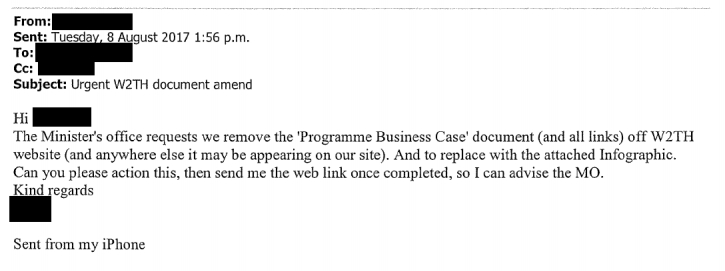
Last month, when the National Party announced ten expensive new roads as the core of its election campaign, the Greater Auckland blog noticed something interesting: the business case for one of them, Whangarei to Wellsford, had disappeared from NZTA's website. Google's cache also suggested why: because the business case found that the road "perform[ed] poorly from an economic efficiency perspective" and should not be built.

The natural suspicion was that the government had ordered the business case removed because it undermined its election promise. And thanks to the OIA, we now know that that is exactly what happened:

NZTA-missing-BC-OIA-Reply-Email-1

Interestingly, Transport Minister Simon Bridges had denied giving any such orders. So either he was outright lying in response to an OIA request, or doesn't know what his own staff are doing. Either way, its not acceptable, and NZTA should not be censoring public information to help with the Minister's election campaign.

Thursday, July 27, 2017


Secrecy vs accountability

While we're on the subject, there's something else in the Ombudsman's report on Simon Bridges' bullying of Kiwirail which is worth discussing: Bridges (or his staff's) views on the "need" to withhold failed budget bids. The Ombudsman quotes these in full, because they're quite an eye-opener:

Noting that the project was highly likely to form a bid for Budget 18, the Minister’s Office formed the view that if the Business Case was released, then it would open the project up to undue influence and public debate which would more likely than not prejudice the path the Budget bid takes.

As the Budget process is a contestable process, negotiations should be allowed to occur unimpeded without any action that could influence the weighting of one bid over another.

This applies to both the future negotiations to be had at a departmental level in the initial stages of the Budget process, and in the subsequent negotiations between Ministers once a bid has progressed to this level.

A bid will be more objective at both stages of the negotiation process if it is on an even footing with other bids (i.e. that haven’t been publically debated). Public and media scrutiny could directly or indirectly influence the weighting of bids and decision making during the contestable budget process. This is the same principle that the Ministry of Transport advised the Office it applies when considering whether to release failed Budget bids under the Official Information Act.

Or, to put that in plain english: policy proposals must remain secret to prevent the public from telling us what they want.

Its an arrogant, undemocratic attitude, which primarily serves to protect those in power from accountability for their decisions. And in this case, there's a lot to be accountable for. The Spinoff has obtained an unredacted version of the Third Main business case, and it shows it to be the best of ten options considered. The option that National chose to fund - more freight by road - was the worst. If Bridges had succeeded in keeping this secret, then we would not know that he had chosen the worst possible option for freight in Auckland. I can understand why he would be interested in that. But we shouldn't be. While Ministers and sniffy public service technocrats may hate the idea, we live in a democracy, and that means making decisions in the public view. If they don't like that, they can fuck off to a country which better suits their preferred style of governance - like North Korea.

National vs the OIA: The verdict

Last month Transport Minister Simon Bridges was caught trying to bully KiwiRail into unlawfully refusing information. Today, the Ombudsman released their report into the incident - made under the Ombudsmen Act, not the OIA - and it is damning. The report examines Kiwirail's administrative process, rather than the lawfulness of the OIA decisions, and while it concludes that Kiwirail was entitled to consult the Minister's office about the request, it is also clear that they failed to critically evaluate his concerns (and so effectively allowed the Minister to make the decision for them). Then, when their conduct was made public, they made a hasty, rushed decision which was not robust. The Ombudsman is also clear that the Minister's initial concerns - that the document was a draft, was misleading, and should be withheld to protect future budget bids - were not valid reasons for withholding under the OIA, and that Kiwirail made the right decision in initially rejecting them.

As for how to fix this, the Ombudsman has recommended that Kiwirail should review its OIA process and adopt a formal protocol for OIA interactions with the Minister. Meanwhile, it looks like the "budget bid" bullshit defence is going to make its way into the FAQ on common OIA misconceptions.

So, that's a win for transparency - and it shows the value in kicking up a stink about dodgy decisions. Its also highlighted a fruitful avenue for requests: metarequests for communications with Ministerial offices about requests. There's probably all sorts of dirt hidden in those, and if Ministers don't want it publicly exposed, they'll have to ensure they respect the proper boundaries and don't try and bully agencies in future.

Friday, June 16, 2017


National vs the OIA 3

Last week we had a blatant example of Ministerial interference in an OIA request, with Transport Minister Simon Bridges trying to bully KiwiRail into unlawfully refusing information. Yesterday the information was released, with substantial redactions suggesting Ministerial pressure. And today we learn that that is exactly what happened:

The new correspondence shows the state-owned company eventually conceded after Mr Bridges' officials escalated the matter to one of KiwiRail's executives.

On 6 June, KiwiRail reversed its initial decision to release the document in full and instead decided to withhold it altogether.

It changed its draft response to read: "Disclosing the document could inhibit KiwiRail from carrying out, without prejudice, future negotiations."

Mr Bridges' staff immediately replied: "The Office is supportive of this response."

However just days earlier, on 1 June, KiwiRail said its legal advice was that releasing the report "would be unlikely to prejudice our negotiations".


Given that the "negotiations" were with the government over budget funding, it really makes you wonder whether the Minister (or their office) told them "if you release this, you won't be getting any money".

This is a perfect example of Ministerial bullying, and of why we want Ministers kept away from OIA responses as much as possible. Ministers are interested not in transparency, but in whether information makes them look good. And they appear to be quite happy to break the law to suppress information which doesn't. The good news is that this has apparently been appealed to the Ombudsman, and with a document trail showing this sort of Ministerial pressure (based on the document supposedly being misleading and wrong - which are not reasons for withholding but rather reasons to release more information along with it), it should be an open and shut case.

Wednesday, June 07, 2017


National vs the OIA

During its time in office National has made it clear that it is hostile to transparency and the OIA. The latest incident? Transport Minister Simon Bridges trying to bully KiwiRail into unlawfully refusing information:

New Zealand First leader Winston Peters tabled an email trail in Parliament yesterday showing that Mr Bridges' office repeatedly urged KiwiRail last week not to release a business case on Auckland's proposed third main railway track.

Initially, his officials opposed the document being released, saying it was part of an unsuccessful budget bid, but were told by KiwiRail on Thursday that the law was clear it should be released.

After consulting its legal team, KiwiRail told Mr Bridge's office it would struggle to justify not releasing it.

But on Friday Mr Bridges' office again urged KiwiRail not to release the business plan.

This time it used a scatter-gun approach - arguing the report was only a draft, was on a misleading template and that its proposed release was making them "extremely uncomfortable".


None of which are lawful reasons for withholding (in fact, all of them appear in the Ombudsman's list of common misconceptions). So, the Minister was telling a crown company to behave unlawfully. And that is simply unacceptable.

More generally, this shows the danger of agencies consulting Ministers about requests. While in some cases it is justified by the "no surprises" convention, it clearly exposes agencies to improper pressure and harassment from Ministers, and may result in unlawful decisions. In fact, I think there's probably a very interesting research project around this: OIA every Minister asking for all correspondence and information on the last ten requests they were consulted on. I suspect there's a lot more dodgy email trails like this waiting to be found...