Showing posts with label Nuclear Free Policy. Show all posts

Tuesday, April 27, 2021


Kicking English nukes out of Scotland?

Scotland is going to the polls on Thursday in parliamentary elections which look likely to be won by the SNP. The most obvious outcome is likely to be another independence referendum and the potential breakup of the UK. But there's something else at stake: the UK's nuclear weapons:

Trident could be forced to the US or possibly France if Scotland became independent because there is no alternative port immediately available elsewhere in the UK, according to a retired admiral responsible for Britain’s nuclear policy.

Unless Scotland were to agree to lease back the Faslane submarine base to the rest of the UK, continuing Trident would probably require the help of an allied country or the nuclear deterrent would have to be halted completely, the expert said.

[...]

“A Scottish secession would therefore generate fundamental operational and fiscal issues for the UK’s nuclear deterrent,” Gower wrote, because Faslane base, the warhead loading site at Coulport, and nearby testing ranges are all based in Scotland or Scottish waters.
Which is England's problem, not Scotland's. Whether to play host to nuclear weapons is ultimately a decision for the Scottish people. They're currently denied that right and forced to host English nukes by the Westminster government (which seems oddly reluctant to base them in England - a prime example of how Westminster treats the rest of the UK like colonies rather than partners). If they vote for independence then kick out these immoral weapons, then England only has itself to blame. And as someone from a country which is already nuclear-free, I'm hoping they do just that.

Tuesday, October 27, 2020


Building a norm against nuclear weapons

Back in 2017, the UN General Assembly approved the Treaty on the Prohibition of Nuclear Weapons, and New Zealand was one of the first countries to sign. Now, a 50th ratification is finally going to bring it into force:

Campaigners have hailed a "new chapter" after a key step by the United Nations towards banning nuclear arms.

Honduras has become the 50th country to ratify the Treaty on the Prohibition of Nuclear Weapons so it will now come into force in 90 days' time.

New Zealand and many Pacific nations including Samoa, Fiji, Niue, Tuvalu, Cook Islands and Kiribati are among the signatories.

Some media outlets (in nuclear-armed states) are calling the Treaty "symbolic", but that's missing the point. Sure, nuclear-armed states and their NATO vassals have refused to sign. But the rest of the world has, and as with a landmine ban, the cluster bomb ban, and the chemical weapons ban, that will be enough to establish a norm that the possession (let alone use) of nuclear weapons is a violation of international law, effectively defining the great powers and their lackeys as rogue states, and companies which support their nuclear weapons as criminal enterprises. The latter are the real weak point, because these multinationals are going to be forced to choose between supporting nuclear weapons programmes, or doing business with the rest of the world. But it should also increase the pressure on governments to disarm - which is an obligation they've already signed up for under the Non-Proliferation Treaty.

Monday, July 10, 2017


Good news for a change

The world seems to be turning into a darker place at the moment, with endless war in the Middle East, and Donald Trump threatening to start even more of them. But over the weekend, there was some light, with the UN formally adopting a treaty to ban nuclear weapons in international law:

More than 120 countries have approved the first-ever treaty to ban nuclear weapons at a UN meeting boycotted by all nuclear-armed nations.

To loud applause and cheers, Elayne Whyte Gomez, president of the UN conference that has been negotiating the legally binding treaty, announced the results of the "historic" vote - 122 nations in favour, the Netherlands opposed, and Singapore abstaining.

"We have managed to sow the first seeds of a world free of nuclear weapons," Whyte Gomez said. "We (are) ... saying to our children that, yes, it is possible to inherit a world free from nuclear weapons."


The treaty is simple, committing its parties to being nuclear free: they won't develop, manufacture, test, transfer, use, or even allow the stationing of nuclear weapons within their territory. And while no nuclear-armed state has joined (and NATO, as good little US vassals, refused to participate), they can, by renouncing their weapons and conducting an IAEA-verified disarmament process. While that probably won't happen soon (again, Trump: an aggressive US makes disarmament less likely), it leaves the door open for gradual denuclearisation. Meanwhile, by establishing a clear prohibition in international law, the treaty has effectively redefined every great power as a rogue state, while reducing their operating scope and providing a basis for future sanctions against them.

New Zealand has been at the heart of this struggle, and we're expected to be one of the first states to sign and ratify it (the New Zealand Nuclear Free Zone, Disarmament, and Arms Control Act 1987 means we're already compliant). Its an actual foreign policy success! Not that National seems proud of it - they blocked a motion in the House to celebrate it last week. But formally prohibiting nuclear weapons in international law is a major achievement, and one all kiwis can be proud of.

Thursday, June 08, 2017


30 years nuclear free

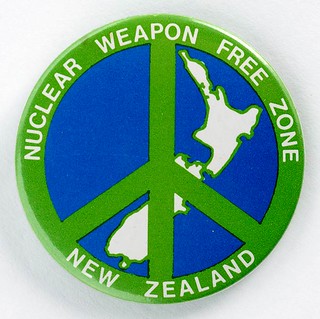
nuclear-badge

Thirty years ago today, the New Zealand Nuclear Free Zone, Disarmament, and Arms Control Act 1987 came into force. The law didn't just ban nuclear weapons from New Zealand - it was also a statement of who we were as a nation: peaceful and independent.

A decade ago when the 20th anniversary rolled around, the nuclear-free policy was still being contested by National party refuseniks who wanted to sell us out to Washington. Now its an accepted fact, political bedrock, which no politician seriously suggests changing. Even the US has now accepted it and gotten over their grudge - and their National minions have followed suit.

But while our nuclear-free status is stable, nuclear weapons are still a threat to the world. Our government should mark the day by reiterating its opposition to them, regardless of who owns them, and re-committing towards their complete global elimination. And if this pisses off the hegemon and causes 3am drunk-tweeting, then so be it.

Monday, November 02, 2015


Against a US ship visit

On Friday, One News broke the news that the New Zealand Navy had invited the US Navy to its birthday party - meaning potentially the first visit by a US warship in 30 years. Or maybe not - because despite 30 years to get used to our anti-nuclear law, not to mention the end of the Cold War and the end of US ships regularly carrying nuclear weapons, the US still refuses to give up its bullshit "neither confirm nor deny" policy. And since visiting New Zealand will either mean officially saying "this ship is not carrying nuclear weapons", or having the Prime Minister say it for them, they might decide to stay away.

Good. Because IMHO they should never have been invited in the first place. In case anyone has forgotten, the US is a torture state currently engaged in multiple foreign wars and a drone murder campaign to remotely assassinate its political enemies. And that should rule it out from being anybody's friend, let alone ours. If we want to consider ourselves a decent nation which stands for peace and international law, we need to stand up against those who oppose those principles. And that means standing up to the biggest war criminal on the planet, the United States of America.

Monday, August 06, 2012


Time for a Nuclear Weapons Convention

Today is Hiroshima Day, on which we remember the US's destruction of the Japanese city of Hiroshima in the world's first atomic attack. The bombing was an atrocity and a crime against humanity. So its particularly appropriate that today the Foreign Affairs, Defence and Trade Committee is recommending [PDF] that the New Zealand government actively support moves for a Nuclear weapons convention outlawing the development, production, testing, stockpiling, use, or threat of use of nuclear weapons.

The recommendation is the result of a petition of Edwina Hughes of Peace Movement Aotearoa, calling on the government to take a leadership role in fast-track negotiations, as it had done on cluster bombs. This would build on our long history of opposing nuclear weapons and supporting disarmament generally.

Unsurprisingly, MFAT - which has generally opposed all that good work out of a desire to toady to the USA - opposed this petition. Having listened to their evidence, the Committee disagreed:

On balance we believe that the time is right for the New Zealand Government to support a nuclear weapons convention. We see New Zealand’s geopolitical role as one of pushing the boundaries towards peaceful resolutions. It has been traditionally ahead of the pack in matters of disarmament, and this is a good opportunity to take an active role regarding the abolition of nuclear weapons, as it did regarding cluster munitions. New Zealand has had a significant impact in this area and we look for this to continue.

While New Zealand is involved with the New Agenda group, their talks are at an impasse. This presents an opportunity to align ourselves with like-minded countries such as Costa Rica and Malaysia. While the ministry says our energies are best spent on measures to achieve small practical steps, we believe a more forthright and proactive approach to the issue is appropriate. The President of the United States recently provided momentum by articulating a vision of a world without nuclear weapons, and we believe now is an opportune time to push for all countries to abandon such weapons.

While we acknowledge the difficulty, complexity, and cost of negotiating a convention, we believe New Zealand should move beyond a position of general support to the forefront of negotiations towards a nuclear weapons convention.

This is good to see. Change doesn't happen by no-one speaking out. Someone has to stand up and argue for it. And on this issue, we should be that person. Its part of who we are as a country. The question now is whether the government will listen.

Friday, June 08, 2012


25 years nuclear-free

Today is a significant anniversary. Twenty-five years ago, on 8 June 1987, the New Zealand Nuclear Free Zone, Disarmament, and Arms Control Act 1987 became law.

The law bans the acquisition or manufacture of nuclear weapons within New Zealand. Not that that was ever likely, but its good to have it written down. More importantly, it bans the stationing and transit of nuclear weapons, and prohibits visits from nuclear-powered vessels. It thus marked a decisive break with the Cold War mentality which saw nuclear weapons as security rather than a threat to humanity. This caused an immediate crisis with the United States, and caused it to reveal its true face as a bullying hegemon interested primarily in keeping its vassals in line. But it has since become part of the bedrock of our foreign policy. Even the National party, always an eager servant of foreign powers (first Britain, then America), has come to accept it, and its repeal today is unthinkable.

But twenty-five years on, there is still work to be done. While the threat of their use has receded, the world still has nuclear weapons. We need to speak up louder for their elimination. We also need to further encourage the expansion of regional nuclear-weapons-free zones, particularly in the Middle East and Europe. Kiwis still want a nuclear-free world; our government should work for that.

Tuesday, June 21, 2011


NZSF supports nuclear proliferation

New Zealand has a proud record of opposing nuclear weapons both domestically and on the international stage. We banned nuclear ship visits in 1984. We helped establish a South Pacific Nuclear-Free Zone in 1985. We have consistently advocated for nuclear arms reduction and spoken out against nuclear proliferation.

Meanwhile, our superannuation fund is helping India build nuclear-armed submarines:

The Green Party is calling on the New Zealand Superannuation Fund to divest from its $2.1 million stake in Larsen & Toubro, a Mumbai-based multinational involved in designing and building a fleet of nuclear-armed submarines for India.

A response to a Green Party Written Question revealed that the New Zealand Superannuation Fund holds 44,595 shares in Larsen & Toubro Ltd, which had a valuation of NZ$2,082,736 on June 9, 2011

[...]

Larsen & Toubro is India’s largest defence engineering company and is partnering with the Indian Navy to manufacture their new fleet of nuclear-armed submarines. They also hold a contract to develop a missile launcher for the Sagarika — a nuclear-tipped, sub-launched cruise missile.

Its not illegal, but it is grossly inconsistent with our foreign policy and our national values. I would expect the Cullen Fund to do better, to be better than that.

Monday, August 09, 2010


In the ballot XXXIX

Another batch of Member's Bills currently in the ballot. Previous batches are indexed here:

Financial Assistance For Live Organ Donors Bill (Michael Woodhouse): would increase the level of financial assistance available to live organ donors. Currently, voluntary donors are eligible for the sickness benefit and childcare allowances during their recovery time; this bill would increase it to the level paid by ACC (80% of lost earnings, for a period of convalescence after the surgery, for a maximum of 12 weeks). The idea is to make it easier to donate organs, without providing too much of a financial incentive to do so, and I think this gets the balance about right.

New Zealand Nuclear Free Zone, Disarmament, and Arms Control (Entrenchment) Amendment Bill (Maryan Street): would do exactly what it says on the label: entrench key provisions of the anti-nuclear law to prevent their repeal without either a supermajority or a referendum. While entrenchment is rarely used in New Zealand (there's only one such clause, protecting key provisions of electoral law), the nuclear ship ban has become a key part of our national identity. This bill would protect that identity, and ensure that no future National government can backslide on it without a broad consensus.

Overseas Investment (Restriction on Foreign Ownership of Land) Amendment Bill (Russel Norman): Amends the Overseas Investment Act 2005 to bar foreigners from purchasing sensitive land. It won't stop people from buying a lifestyle block or holiday home, but it will bar them from buying farms, large areas of beachfront, or any land held for conservation purposes. If they want to own those things, they'd have to move here, rather than being an absentee landlord.

As usual, I'll have more bills as I acquire them.

Wednesday, December 10, 2008


Global Zero

Today a new international campaign for the elimination of nuclear weapons was launched in Paris: Global Zero. The campaign brings together 100 leading world figures - politicians, business and civic leaders, and human rights advocates - all pledging to work towards the final elimination of our nuclear arsenals. They're aiming to build a grassroots movement to pressure governments - not that it will be hard; a poll of citizens in 21 countries found overwhelming support for total nuclear disarmament, even in nuclear-armed states. The only country where disarmament did not have an absolute majority was Pakistan, and even there supporters outnumbered opponents.

This is a cause New Zealand and New Zealanders should be supporting. You can show your own support by signing the declaration. But more than that, the New Zealand government should be lending its support to this cause. While NZ wasn't included in Global Zero's poll, this is a cause that we as a country believe in. Our newly-elected government should recognise that, and represent our beliefs on the global stage. After opposing the domestic nuclear ban for so long, National needs to build trust on this issue. This is an opportunity for them to do so.

Wednesday, October 03, 2007


Labour betrays us on nuclear disarmament

In her address to the Oxford Union the other day, Helen Clark also stressed New Zealand's opposition to nuclear weapons, saying:

We continue to be very active on nuclear disarmament issues, working with colleagues in the New Agenda grouping of nations. In 2000 that grouping persuaded the membership of the Nuclear Non Proliferation Treaty to agree to thirteen practical steps on nuclear disarmament and non proliferation.

Since then nuclear disarmament has tended to take a back seat, as counter proliferation efforts have come to the fore. Yet while undoubtedly important, those efforts should not blind us to the risk nuclear weapons per se pose to global security.

Like her rhetoric on human rights, this is a statement that most New Zealanders would agree with. And like her rhetoric on human rights, Clark's government is failing to live up to it. Just two weeks ago, at the annual conferance of the International Atomic Energy Agency in Vienna, the New Zealand government betrayed our anti-nuclear principles by joining European governments in abstaining on a motion calling for a nuclear-weapons free zone in the Middle East. The government's excuse is that "poor consultation and lack of process" meant that New Zealand could not support the draft. But that's a little disingenuous. Looking at the actual motion [PDF], the clauses we objected to are ones that any state which opposes nuclear weapons should be proud to support:
4. Further calls upon all States of the region, pending the establishment of the zone, not to develop, produce, test or otherwise acquire nuclear weapons or permit the stationing on their territories or on territories under their control, of nuclear weapons or nuclear explosive devices, or to pursue actions that would undermine the goal of establishing the zone;

[...]

6. Urges the nuclear-weapon States and all other States to render assistance in the establishment of the zone and at the same time to refrain from any action that would hinder efforts aiming at its establishment.

So why did we abstain then? The answer is simple: the new clauses specifically targetted Israel, the only nuclear-armed country in the Middle East, and were strongly supported by Arab nations. So rather than offend Israel or its American backers, our government betrayed its nuclear-free principles - and its voters. It's nice to know who they think is important.

Friday, June 08, 2007


Proudly nuclear free

Twenty years ago today, Parliament passed the New Zealand Nuclear Free Zone, Disarmament, and Arms Control Act 1987. The law did more than just ban the manufacture, deployment, or use of nuclear weapons in New Zealand, or the entry of nuclear powered vessels into New Zealand waters - it was also a decisive statement of our principles, our independence, and our commitment to a world free of nuclear weapons. For people of my generation, it was the struggle to be nuclear free, rather than the massacre of Gallipoli, when New Zealand really came of age.

Twenty years on, that statement of principle and that coming of age are well worth celebrating. It's also worth protecting. A couple of years ago, Tony Milne floated the idea of holding a referendum on entrenching the anti-nuclear legislation to prevent it from being sold out from under us by future politicians who owe greater allegiance to Washington than Wellington. After twenty years of being proudly nuclear free, i think it is an idea whose time has come.

Wednesday, February 08, 2006


But do you believe them?

National is apparantly revising its nuclear policy back to support of the status quo. And if you believe that, there's a bridge in Auckland I'd like to sell you. This is, after all, the party that believes in "a moral obligation to lie"...

I'm with Tony Milne on this one: we should be looking at a referendum to entrench the anti-nuclear legislation, to ensure that it can't be sold out from under us by politicians who owe greater allegiance to Washington than New Zealand. I don't think there'd be any problem gaining a Parliamentary majority to pass the required legislation - both the Greens and NZFirst would back it, as would (probably) the Maori Party. Perhaps someone should draft a private member's bill on the subject...?

Tuesday, July 19, 2005


The advertising campaign Labour should be running

Just Left has a series of pictures from the advertising campaign Labour should be running, attacking National on its foreign-run foreign policy and its duplicitous stance on the anti-nuclear issue. They have apparantly been appearing all over Auckland and Wellington - in which case good on whoever is doing it. They are far more effective than flying babies or cartoon chainsaws, and make it crystal clear what the difference between the parties is.

Why are these ads effective? Because they are true. And they are helped by National's continued attempts to hide it. This week's Listener has a Gordon Campbell piece in which Don Brash falls all over himself trying to avoid answering basic foreign policy questions:

The war on terrorism - and not the Cold War - is now the abiding concern of our former ANZUS allies. Would Brash, if elected, have any objection to us playing a military role in Iraq - especially given the recent news that Australia will now be playing a larger military role in southern Iraq to enable British troops to be redeployed to Afghanistan? "I don't have the information to make sensible comment on that,", he says.

So, if Brash ever received a call from Whitehall, Canberra and Washington to participate militarily in Iraq, would he consider it positively? "To answer that sensibly, you need to know a lot more about New Zealand's military capacity and related issues than I've certainly got in Opposition..."

But he wouldn't rule out a military role in future? "I don't think I've got enough information to answer that."...

Meanwhile, Scoop has a nice collection of National's former statements on Iraq, promising support and to do anything or go anywhere the White House tells us. "Not enough information"? Yeah, right.

But while I like the Iraq ads, I have to admit that my favourite is this one:

Again, it makes it clear exactly what is at stake - though possibly its just my perverse appreciation for mushroom clouds...

Tuesday, July 05, 2005


Ending the standoff

So, the US Ambassador has made another speech calling for us to "end the standoff" with the US. To which we really have to ask "who is standing who off"?

As Helen Clark pointed out, the door is open, and it has always been open. What she very diplmatically didn't say is that it is only US arrogance that has stopped them from using it. France and the UK - both nuclear powers - have been happy to comply with our anti-nuclear legislation when visiting New Zealand. It is only America's refusal to accept that legislation that has prevented visits by their forces.

As for the wider relationship, I have nothing against closer relations with the US. But what they must accept is that we are an independent nation, with our own values. Where those values differ from those of the US - as they did on Iraq, and as they do on climate change, fair trade, the need for international law, and on multilateralism generally - we (along with the rest of the world) will go our own way. We have a lot in common, but we are interested in being friends, not vassals.

Thursday, June 09, 2005


Wedge issues

The usual ballot for private members bills was held today, and two new ones have been drawn for consideration by the House. And as seems usual for private members' bills these days, both deal with highly divisive "wedge issues".

The first is Ken Shirley's bill to amend the New Zealand Nuclear Free Zone Disarmament and Arms Control Act 1987 to allow nuclear-powered ships into New Zealand waters. This is pretty much an anathema to most new Zealanders, and I expect it to be voted down in short order by Labour, the Greens, Progressives, and probably (judging by their defence policy) NZFirst. But they're not the real target. As can be seen from Shirley's press release, the real target is National. While Don Brash famously promised that the nuclear ban would be "gone by lunchtime" if he were to become Prime Minister, he has since backed down, declaring that he would not change the anti-nuclear policy "at this point". Meanwhile, despite holding a review, the National Party has refused to adopt a formal position on the issue. This bill will force them to jump one way or the other, and no matter which way they choose, ACT will be able to score points with those who believe that our role is one of subserviance to the US, either by claiming to have led opinion or to be the "purer" (more subserviant) party of the right.

The second is Sue Bradford's Crimes (Abolition of Force as a Justification for Child Discipline) Amendment Bill, which will (as ought to be obvious from the title) repeal section 59 of the Crimes Act 1961 and effectively outlaw child-beating under colour of parental authority. Given the recent acquittal by a jury of a woman who beat her child with a horse whip, I think the law is sorely in need of changing - you only have to read the woman's long history of violent abuse of her children to see that the law is being used to shield outright abusive behaviour. Unfortunately, I'm not sure the numbers are there, and authoritarian conservatives will make hay from the issue. And on the griping hand, nothing changes unless you try, and if this bill fails, we'll just have another go in a couple of years.

Both bills should probably get their first reading around July 27th, so if you care about the issues, start lobbying.

Update: Added links to bills on Knowledge Basket.

Tuesday, April 05, 2005


Broken records

Sigh - yet another visiting American politician saying that we should "re-evaluate" (meaning drop) our anti-nuclear policy. Why? Because

"[a]s of now, North Korea has the capability of launching missiles with nuclear warheads which can reach many cities along the West Coast of the United States. If these missiles can ... target San Francisco and Los Angeles, they can just as easily reach the cities of Auckland and Wellington."

Which is entirely true - but its difficult to see how having other people's nukes here would help one iota in stopping them.